
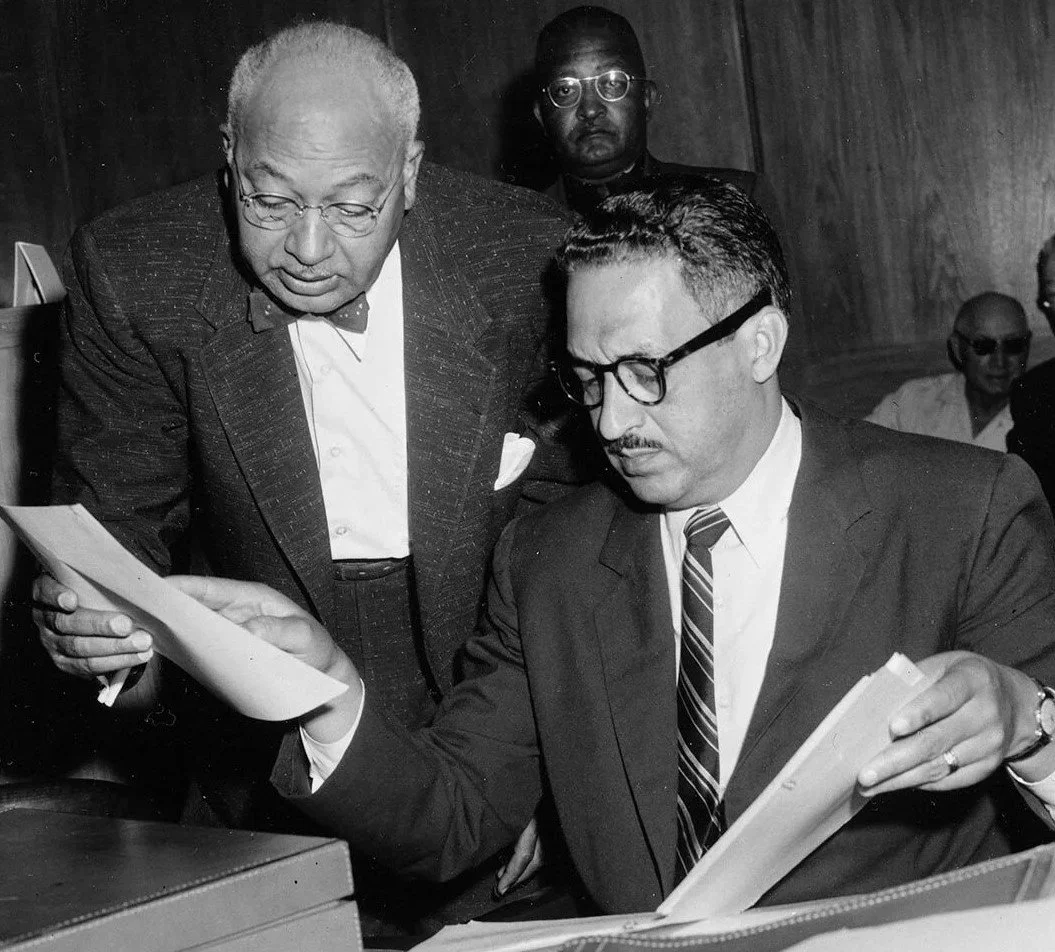
Thurgood Marshall in Columbia
Years before he became the first Black justice on the U.S. Supreme Court, Thurgood Marshall came to Columbia as part of the NAACP’s legal fight for the men charged after the 1946 uprising. Before his work here was finished, he narrowly escaped an attempt on his own life.
After the raid, Mary Morton contacted the NAACP and appealed for help. Maurice Weaver and Z. Alexander Looby were among the first attorneys to arrive in Columbia, coming within days of the arrests. They began working to gain access to the prisoners, investigate their treatment and build a defense for the Black men facing charges.
Thurgood Marshall, one of the NAACP’s leading civil rights attorneys and the founder and chief counsel of its Legal Defense Fund, arrived in Columbia in May 1946. The organization, led by Walter White, assembled a legal team that included Z. Alexander Looby, Maurice Weaver, Leon Ransom and Thurgood Marshall. Together, they sought not only to defend the men charged after the uprising, but also to challenge the racial inequality surrounding their arrests, treatment and prosecution.
One of Marshall’s most important early roles was leading the effort to move the trials out of Maury County. The defense argued that Black defendants could not receive a fair trial in Columbia, where no Black man had served on a jury in more than 50 years.
To make that case, Marshall brought more than 100 Black men to the stand to testify about their exclusion from jury service. The court granted the change of venue, and the cases against 25 defendants were moved to Lawrenceburg, Tennessee.
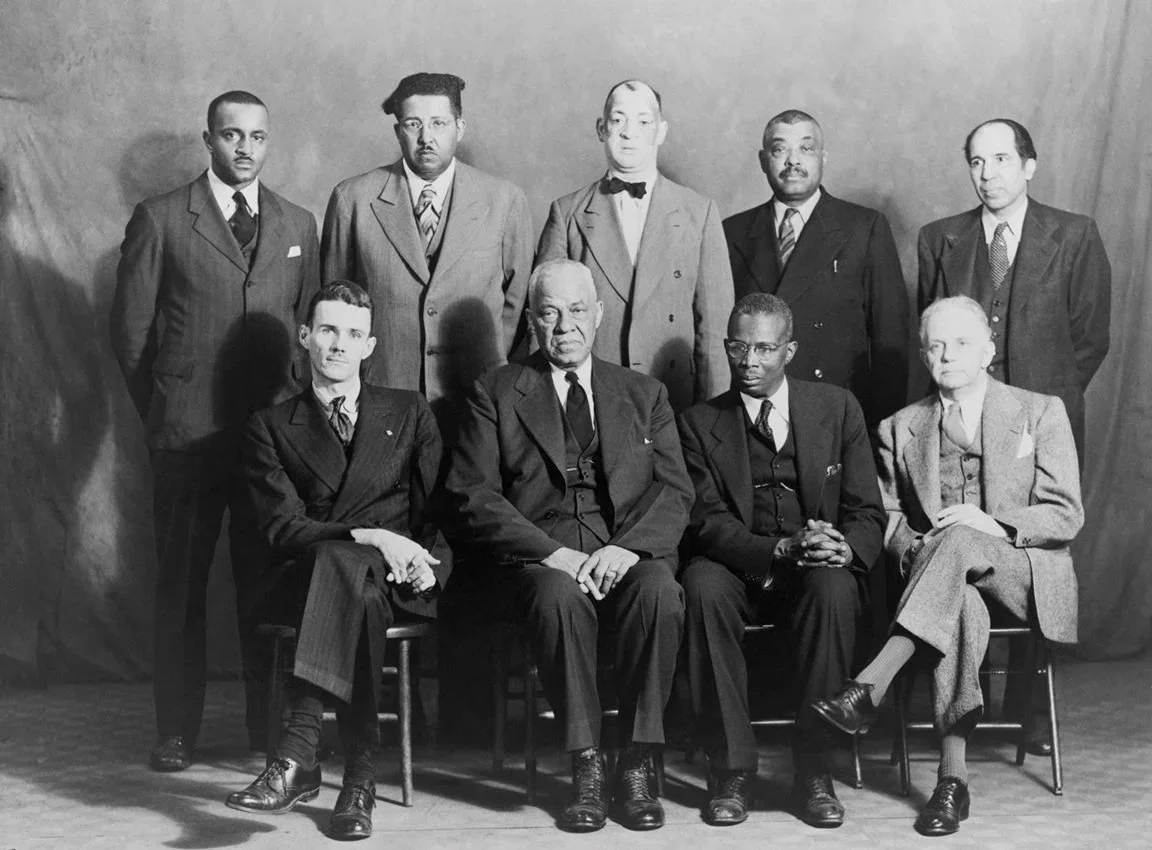
Defendants and NAACP counsel in Columbia. Seated left to right: Maurice M. Weaver, Julius W. Blair, Z. Alexander Looby, and Walter White. Standing left to right: James Martin, James E. Morton, Charles E. Blair, Sol W. Blair, and M. G. Ferguson.
Marshall became seriously ill before the Lawrenceburg trials began and returned to New York to recover. But his involvement in the case did not end. He remained apprised of the proceedings from afar while Looby and Ransom took leading roles in the courtroom.
In Lawrenceburg, an all-white jury acquitted 23 of the 25 defendants. Robert Gentry and John McKivens were found guilty, but a judge later granted them new trials. Due to lack of evidence, the charges against both men were eventually dropped.
Challenging the State’s Case
Marshall returned to Columbia in November for the separate cases against Lloyd “Papa” Kennedy and William “Rooster” Pillow, two additional defendants who were not among the 25 tried in Lawrenceburg. His most significant courtroom role in Columbia came in their defense.
Kennedy and Pillow had been found inside Saul Blair’s barbershop during the February raid. The state alleged that gunfire had come from the building and sought to connect the two men to the shooting.
Marshall focused on what the evidence could—and could not—prove.
He questioned whether witnesses could reliably identify who had fired, pointed to conflicting accounts of what officers had seen and emphasized the lack of evidence connecting either defendant directly to the gunfire. He also challenged law enforcement’s failure to preserve and present the shotguns said to have been used. Officers had confiscated hundreds of weapons during the raid, yet the guns central to the prosecution’s theory were not produced in court with evidence tying them to Kennedy or Pillow.
Marshall argued that the two Black men were being tried on evidence that would not have been considered sufficient against white defendants. He insisted that their cases be judged by the same principles of equal justice and due process that applied to every American citizen.
Pillow was acquitted. Kennedy received a reduced sentence that allowed him to go free on bail.
Marshall’s work in Columbia reflected the legal strategy that would define much of his career: exposing the unequal operation of the law while insisting that the courts live up to the guarantees of the Constitution.
“I am shocked at seeing a trial of this type, and I say at the beginning, that the Attorney General would not dare to try two white men on the type of evidence that has been presented in this case.”
—Thurgood Marshall, Kennedy Pillow Trial Defense Summations
The Attempt on Marshall’s Life
On November 18, 1946, Marshall was in Columbia for further proceedings involving Kennedy and Pillow. After court, he left for Nashville with members of the legal team and Harry Raymond, a reporter for The Daily Worker.
Their trip out of Columbia was interrupted by law enforcement several times. Looby had been driving during one of the earlier stops, but the men later switched drivers. Marshall was behind the wheel when police stopped the group again after they crossed the Duck River bridge on Nashville Highway.
Three police cars surrounded them. The vehicles carried both uniformed officers and armed civilians. Officers falsely accused Marshall of driving while intoxicated, although he had not been drinking, and placed him under arrest.
They did not take him directly back to the courthouse.
Instead, the police car carrying Marshall turned off the highway onto a dirt road near the Duck River, where more white men were waiting.
Marshall’s companions understood the danger. Looby took the wheel of their car and, rather than following officers’ instructions to continue toward Nashville, followed the police car carrying Marshall. Local Black residents, including World War II veteran Milton Murray, also intervened as word spread that Marshall was in danger. Their actions disrupted what Marshall and those traveling with him understood to be an attempt to lynch him.
The officers eventually took Marshall to Magistrate Jim Pogue. Pogue reportedly asked Marshall to breathe toward him, explaining that as a teetotaler he could “smell liquor a mile away.” After determining that Marshall had not been drinking, he told the officers to let him go.
Marshall was released, but his colleagues did not believe the danger had passed.
Escaping Columbia
After Marshall was released by Pogue, he returned to the Mink Slide where local Black residents helped him escape. Looby arranged for a decoy car to travel along Nashville Highway while the vehicle carrying Marshall left Columbia by another route.
The precaution proved justified. Police stopped the decoy vehicle, and when they discovered Marshall was not inside, the driver was badly beaten. Marshall escaped Columbia and returned safely to Nashville.
Marshall later said he had never been more afraid for his life than he was in Columbia. His narrow escape underscored the risks faced by the attorneys who came to defend Black residents in the aftermath of the uprising.
A Moment That Stayed With Him
Marshall went on to become one of the most consequential attorneys in American history. He later helped argue Brown v. Board of Education before the U.S. Supreme Court, contributing to the 1954 decision that overturned the doctrine of “separate but equal” in public education.
In 1967, President Lyndon B. Johnson nominated him to the U.S. Supreme Court, making Marshall the first Black justice to serve on the Court.
But Columbia remained part of his story.
The legal fight here demonstrated how organized advocacy and courtroom challenges could confront racial inequality within the justice system. It was an early example of the approach Marshall would carry into some of the most important civil rights cases of his career.
Marshall came to Columbia to defend Black men whose community had refused to accept another threatened lynching. His experience here became part of the larger fight for equal justice that would define his life’s work.
Watch Thurgood Marshall talk about his experience in Columbia.
Honoring Thurgood Marshall in Columbia
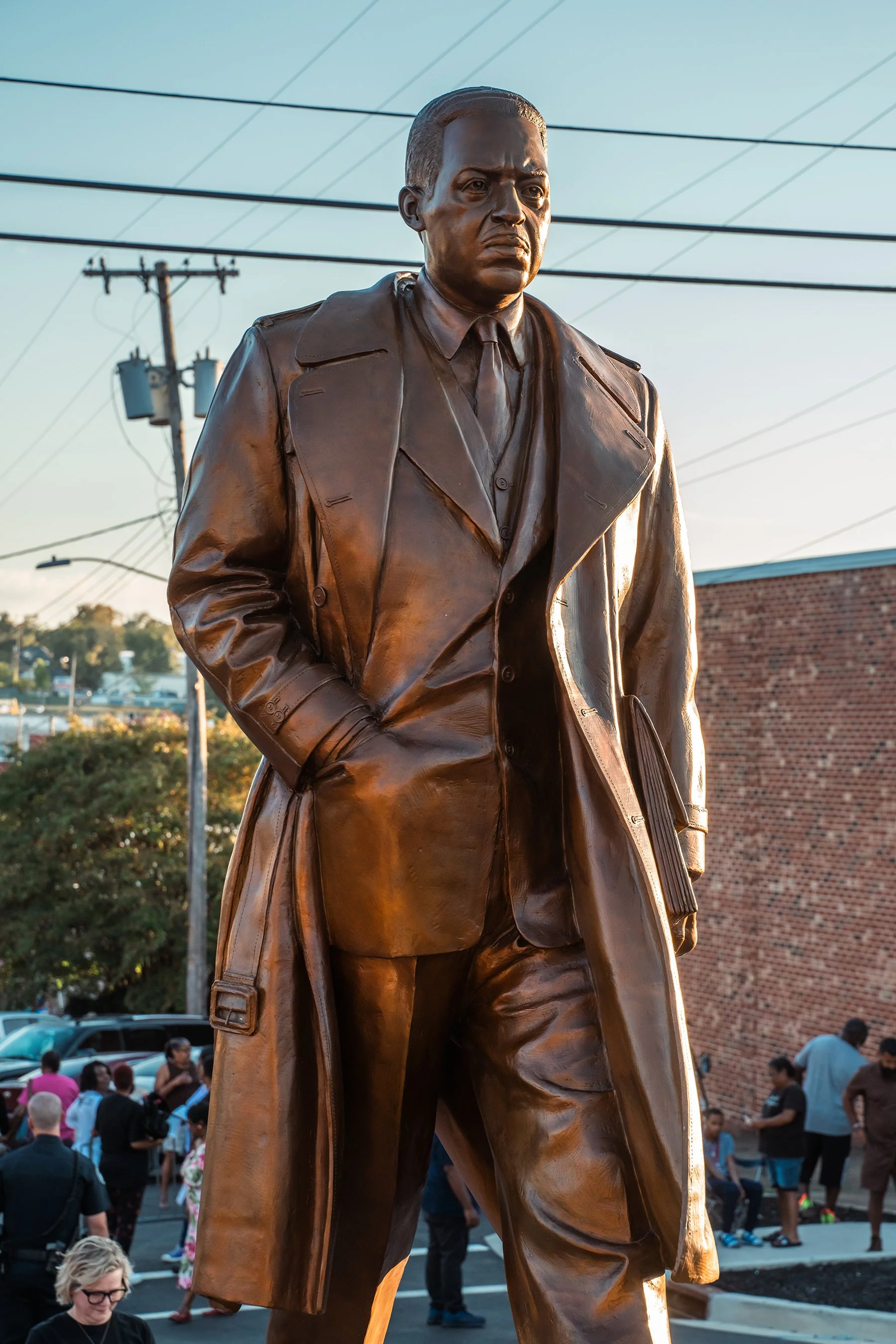
CPJI, in partnership with the City of Columbia, honored Thurgood Marshall with a monument on East Eighth Street, at the gateway to Columbia’s historic Black business district.
Created by sculptor David Alan Clark, the monument depicts Marshall at age 38, striding from the riot-damaged district toward the Maury County Courthouse. A shattered noose beneath his feet reflects the racial violence he confronted and narrowly escaped while working in Columbia.
The project recognizes Marshall’s role in the legal fight after the uprising while helping draw attention to the many other people whose courage shaped the events of 1946. Informational markers surrounding the monument introduce visitors to that broader history and encourage them to learn more about Columbia’s place in the Civil Rights Movement.